Professional protocol of the Hungarian National Resource Ministry
Introduction
This publication aims to summarise for parents/carers the essential things to know about caring for a child with a fever at home. The guide was prepared on the model of the parent information leaflets already widespread in Western Europe, adapted to Hungarian conditions.
The frequency of feverish conditions in childhood, the often unverified material circulating in the press, on the internet and elsewhere, and the parental worry and frequent helplessness that fever causes all made it justified to have a Hungarian practical publication to help people find their way.
In the part of the publication dealing with medication we write about principles, not doses, because new products may appear.
Fever reducers are nowadays given mainly to improve comfort. For this purpose it may be advisable to keep a fever reducer at home. The dosage of the fever reducer must follow the patient information leaflet supplied with the product, unless the doctor prescribes otherwise.
Fever in childhood
Fever is a frequent condition in childhood, accompanied by raised body temperature. Fever is not the cause of illnesses, only an accompanying symptom! Fever can even be useful as part of the body's defence against illness. Even so, its appearance can often be alarming for parents/carers, so they frequently turn to the doctor. Fortunately, in the vast majority of cases a feverish condition resolves quickly and without problems, even with care at home.
However, it may happen that the expected improvement does not come soon, or a worsening of the condition is observed. These rare complications can be signs of a serious illness or infection, so seeing a doctor is absolutely justified in such cases!
A feverish state also involves increased fluid loss for the body, which is very important to replace in order to avoid dehydration!
In a feverish child in poor general condition, it may be advisable to start lowering the fever even before turning to the treating doctor. Fever reduction started in time can often also make the medical examination easier.
If the general condition gradually worsens, however, a doctor must be seen without delay.
Fever and the severity of the patient's condition
A higher body temperature requires attention. At the same time, the level or duration of the fever alone is most often not suitable for judging the severity of a child's condition. This is especially true for very young infants!
Fever rarely occurs in infants younger than 6 months. If it does occur, it must be taken very seriously, because it can even accompany a serious illness.
A fever of 38 °C or higher in an infant younger than 3 months, or a fever of 39 °C or higher in an infant aged 3–6 months, generally justifies a hospital examination!
In this age period, however, a higher fever may also appear as an unwanted effect of the compulsory and recommended vaccinations, which can occur in the few days after the vaccination without any serious illness in the background. Distinguishing this from a serious condition is a medical task, so a doctor must be consulted in such cases too.
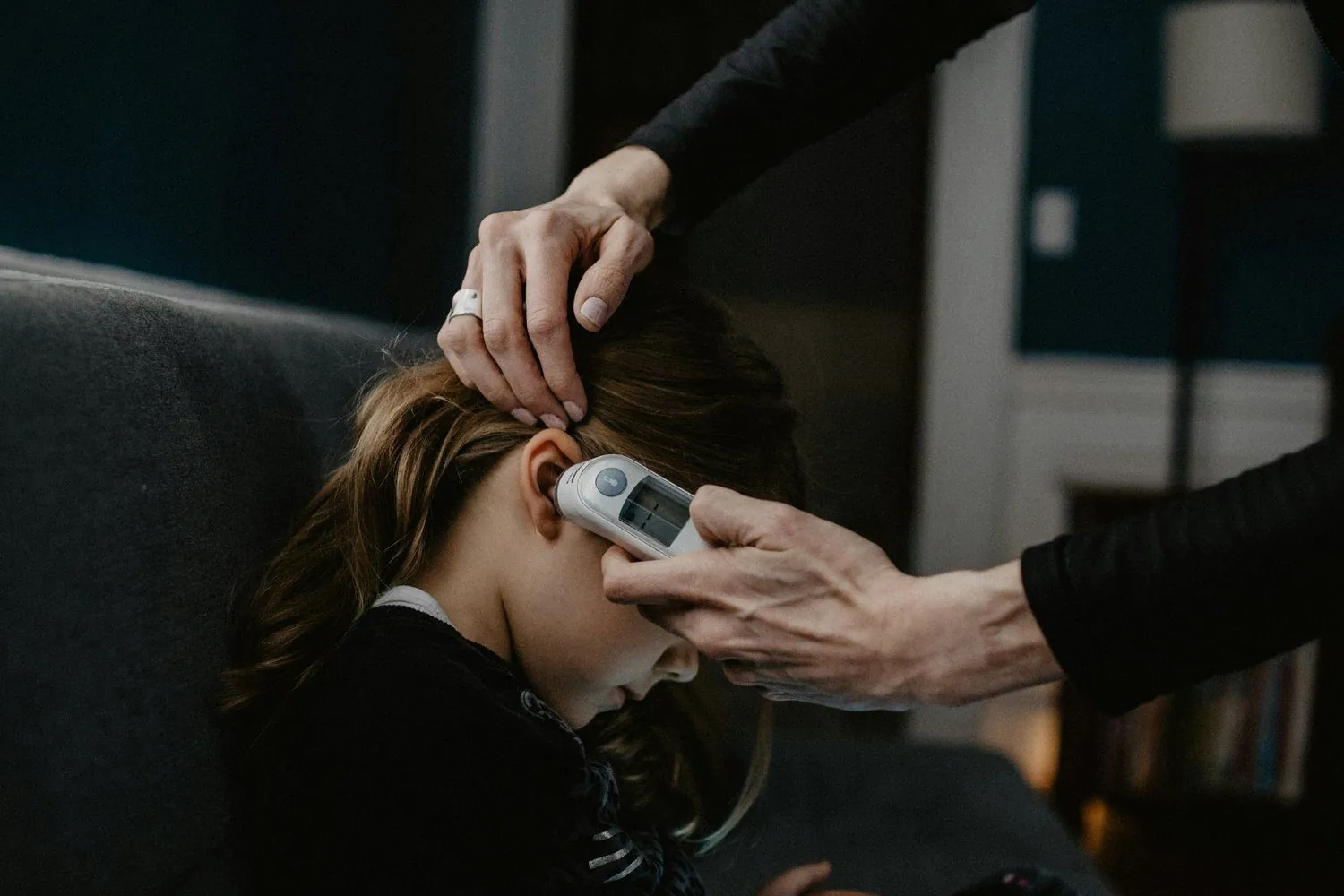
In infants, body temperature is most reliably measured in the rectum. Measured in the rectum, the value shown by the thermometer is 0.5 °C higher than when measured in the armpit – see the table!
Values measured in the armpit:
- 36–37 °C normal body temperature
- 37–38 °C raised temperature
- 38–39 °C moderate fever
- 39–40.5 °C high fever
- above 40.5 °C very high fever
Values measured in the rectum:
- 36.5–37.5 °C normal body temperature
- 37.5–38.5 °C raised temperature
- 38.5–39.5 °C moderate fever
- 39.5–41 °C high fever
- above 41 °C very high fever
Questions to expect first
If you call the doctor's surgery/on-call service because of your child's fever, be prepared to be asked about your child's general health and other symptoms as well. So try to find out about these in advance as precisely as possible. This is important because these answers often help decide whether advice for care at home is enough or immediate medical examination is needed.
In a complicated case, of course, an ambulance can also be called.
Examination of the patient and finding the cause of the fever
The doctor examines your child in order to find the cause of the fever and to rule out the possibility of serious illnesses/infections. To this end the examining doctor may also order other diagnostic tests (blood test, urine test, X-ray), and may refer your child to hospital immediately.
It can happen that even a full examination does not find the cause of the fever right away. What happens next is also decided during the examination.
In most cases feverish children can be cared for at home. Occasionally, however, medical check-ups may be needed even then! You must also tell the doctor if care at home cannot be arranged!
Only a very small proportion of children need hospital admission or investigation because of a feverish state.
Availability, and the possibility of asking for further help
It is also advisable to clarify whether in such a case you can contact the health service by phone or in person at any time of the day, including at night.
It is also advisable to give your own contact details (so they can call you back!)
From the health professionals you can also get advice on warning symptoms and on when to ask for further help.
Useful questions to ask the doctor/health visitor/nurse
- How can the feverish state be made more bearable?
- When and how is it worth asking for help?
- How can a feverish child be checked at night as well, if necessary?
Reducing the fever
Certain medicines (fever reducers), e.g. paracetamol, amidopyrine and ibuprofen, make the fever easier to bear and also reduce it. The anti-inflammatory effect of ibuprofen also helps. At the same time, these agents do not cure the illness causing the fever, and they cannot be used to prevent febrile seizures.
Fever-reducing medicines serve to lower the fever and improve the patient's comfort. For this purpose they may safely be given to a feverish patient if there is no other exclusion (e.g. allergy to the given agent). The two kinds of fever reducer must not be given at the same time, however! If one did not help, the other can be given later.
With fever reducers, as with other medicines, always read the patient information leaflet carefully or ask your treating doctor for further information, in order to avoid the danger of overdose!
Attention! Giving salicylate-containing fever reducers (e.g. aspirin, Kalmopyrin) is not recommended under the age of 10! Antibiotics are not fever reducers, and they may only be started on medical instruction.
In the past decade, physical fever reduction has been criticised a great deal, mainly because of the unpleasant subjective experience. In many places this method is therefore not even recommended. At the same time, in the case of a high fever, gentle, moderate, carefully applied and tolerable physical cooling combined with medicinal fever reduction can be effective. Using it can also spare the body from the often unnecessarily frequent administration of medicines.
For a child, a gently performed cooling bath can mean the least subjective discomfort. Shivering must be avoided in any case, because it hinders the release of heat.
It can help if we cool the bath water, which starts at the current body temperature (so not cold!), slowly and carefully until it becomes uncomfortable, but do not cool the water below 31 °C even then! Stir it often, and splash the child's body with the pleasantly lukewarm water.
Never use ice-cold water! Never leave a feverish child alone in the bath!
Cooling is more effective if the water reaches only chest height, and the body surface left free is continuously splashed with the mixed water, as if the child were sitting in water up to the neck.
Do not continue cooling once the body temperature has dropped to 38 °C!
A cooling bath for a child with a heart condition may only be given very carefully and, of course, only under close supervision!
If blue discolouration (cyanosis), stronger signs of circulatory disturbance, or increased shivering and chattering of the teeth appear, the compress must be stopped immediately and the child taken out of the tub, because in such cases we may cause the opposite of the expected effect.
In such a case the patient's body must be dried and left uncovered for a while.
When covering a feverish child, avoid thick blankets and duvets, because by hindering the release of heat they may cause heat retention, and the fever does not come down.
Other advice
- Make sure the child drinks regularly (for a breastfed infant, breast milk is best), to avoid fluid loss and dehydration
- Watch for the signs of dehydration (dry mouth, coated tongue, absence of tears, sunken eyes, a fontanelle sunken relative to the level of the top of the head (the fontanelle is the small round "soft spot" on top of an infant's head), less urine).
- Encourage the child to keep drinking if you notice signs of dehydration. If there is a problem, ask a professional for advice again!
- How can you tell skin rashes from skin bleeding on the child's body with the glass test*?
- A feverish patient should not go to nursery/school or other communities!
- Do not dress children too lightly or too warmly!
- Do not use cold/ice baths or wrapping in a wet sheet!
- If the cause of the fever is not known, it is not right to give antibiotics! These may only be used on medical instruction.
*glass test
Gently press a glass tumbler against the skin area in question – if, looking through the glass, the skin mark does not fade, it is most likely skin bleeding. If you notice this, see a doctor immediately!
Further immediate help is needed if:
- you notice skin bleeding that does not fade with the glass test, at any time during the illness
- the child has a seizure
- the child's drowsiness increases or the child cannot be woken
- you notice signs of dehydration in the child even though the child is drinking
- new, unusual symptoms appear
- the child's general condition gets worse
- the fever has lasted more than 3 days
- care of the child at home cannot be arranged
Febrile seizure
A febrile seizure can occur with fever in at least 3% of children aged 6 months to 6 years.
What to do in case of a febrile seizure
- Stay calm
- If possible, note when the seizure starts and ends!
- Stay with the child
- Turn the child onto their side
- Remove all dangerous objects from around the child, e.g. furniture with sharp corners
- Place something soft under the child's head so that the child does not hit their head on the floor
- Do not give the child anything by mouth
- Consult a doctor
Calling an ambulance immediately is justified if the seizure
- lasts longer than 5 minutes, or
- if your child was in water at the time and had breathing difficulty as a result
- if the child suffered a head injury
- if the child's breathing does not settle after the seizure, or if the lips remain blue
A medical examination is also justified if the seizure
- is your child's first seizure
- if you are unsure whether your child's condition has settled after the seizure
Write it down! Contact details of the paediatric on-call service (address, phone)
Source: http://www.kozlonyok.hu/kozlonyok/Kozlonyok/6/PDF/2011/7.pdf (in Hungarian)